
| | | | |
| | |
Arshin Mal Alan - Libretto
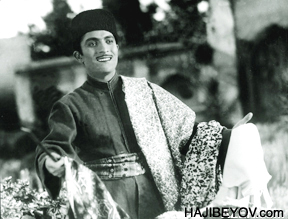
The music in Uzeyir Hajibeyov's comedy
"Arshin Mal Alan" [1913] has been described as the most optimistic
music of pre-Revolutionary Azerbaijan [prior to 1920]. No work expresses
more hopefulness and optimism for the future than this one.
Stalin understood this optimism. At the height of World War II, when the
Soviet Union was suffering immense casualties, he organized for this musical
comedy to be made into a film. The movie was released in 1945. The following
year, it was awarded the Stalin Award. This honor was also bestowed upon
the composer, the producer, the musical editor and the conductor, Niyazi,
Hajibeyov's nephew. Niyazi refused the medal, insisting that it was the
composer of the score and libretto -
Hajibeyov - who alone deserved the
award. However, Hajibeyov is said to have passed the money on to Niyazi,
who had been involved in adapting the original score for film.
In "Arshin Mal Alan", Hajibeyov continues to develop his favorite
theme of freedom and choice for young people in choosing their marriage
partners. It was the same thread that defined his first opera, "Leyli
and Majnun" (1908) and reappeared in the two musical comedies that
preceded this one: "Husband and Wife" (1910), and "O Olmasin,
Bu Olsun" (1911).
At the turn of the 20th century, it was customary for Azerbaijani families
to choose spouses for their sons and daughters. Many parents guarded their
daughters so well that young men never even had a chance to get a glance
at them, much less get to know them. But Hajibeyov felt that for such
an important, life-determining step, young people themselves ought to
take part in the decision-making process. He believed such choices should
not simply be made on the basis of social status, wealth, class or beauty.
The story of "Arshin Mal Alan" is based on the dilemma of a
young wealthy businessman, Asgar, who feels he has everything in life
except the ability to choose his own bride. Everything is ideal except
for this one thing.
But Asgar is determined to choose his own bride and not let others make
the decision for him, as was the custom. "Look, I'm a merchant,"
he would say, "don't I always examine goods carefully before purchasing?
Then why should it be any different when it comes to choosing the woman
I'm going to spend the rest of my life with?" But despite his intelligence,
wealth and social status, he is never able to figure out how to counter
the strong practices and traditions prevalent in the society.
Enter Suleyman, Asgar's friend. "The only man who ever gets a chance
to see any women is the peddler who sells cloth. So why don't you take
a yardstick ("arshin") and some samples of cloth ("mal")
and roam through the alleys selling your goods? That way, you'll be invited
into the courtyards and homes, and you'll get the chance to discover the
girl of your dreams."
So Asgar disguises himself as a poor peddler and begins wandering the
streets and lanes selling material goods. All day long he calls out, "Arshin
mal alan!" (Buy measured goods!) As the days pass, Asgar sees many
women, but he can never find one who captures his imagination or his heart.
As luck would have it, Asgar is not the only one who wants to meet the
love of his life. Gulchohra, the daughter of Sultan Bey, has the same
dream. And so it happens that one day, while passing Sultan Bey's house,
Asgar is invited in to display his array of materials. And that's when
it happens. The moment he set eyes on Gulchohra, he realizes that she
is the woman he has been looking for. It is love at first sight for both
of them.
Soon afterwards, Asgar sends his aunt (as was the custom) to ask Sultan
Bey if he can marry his daughter. Now his aunt, it turns out, is a widow
and Sultan Bey just happens to be a widower in search of a wife himself.
When Sultan Bey meets Asgar's aunt in the courtyard, it doesn't take him
long to propose. The cloth peddler, who has not yet made his identity
known, sees his chance to strike a deal with Sultan Bey. "I'll give
you permission to marry my aunt if you, in turn, allow me to marry your
daughter."
Sultan Bey becomes enraged. "What?! You scum, you scoundrel! Never,
ever would I allow my daughter to become the wife of a poor peddler! Get
out of here!" So Asgar leaves, once again perplexed.
Suleyman again tries to come to Asgar's rescue. This time he proposes
to go to Sultan Bey, whom he knows personally, and suggest that Gulchohra
be married to Asgar, whom he would describe as the merchant that he really
is, not the poor peddler in disguise. Asgar agrees.
Sultan Bey is easily persuaded by Suleyman's proposal. "Why not?"
he reasons. "Asgar is young. He's rich. And he's one of the most
respected men in the city." And so it is settled. Except for one
thing. Gulchohra has already made up her mind that she wants to marry
the peddler, and that she will have nothing to do with any rich merchant.
And so Asgar resorts to the practice of the day of kidnapping his potential
bride. Gulchohra, still not aware of the situation, is broken-hearted
and starts to contemplate suicide until she recognizes Asgar's voice as
being the same as the cloth peddler's that she has fallen in love with.
The final scene is a wedding, celebrating not only the marriage of Asgar
and Gulchohra, but that of three other couples as well: Sultan Bey and
Asgar's aunt, Suleyman and Gulchohra's cousin Asya, and the servants of
both Asgar and Gulchohra.
Despite the buoyant optimism and enthusiasm found in "Arshin Mal
Alan", it was to be Hajibeyov's last major musical composition before
the world collapsed around him and the Bolsheviks took Baku (1920). Nearly
25 years would pass before Hajibeyov would again produce a major piece
worthy of his genius - "Koroghlu" (1937).
| | |
